
Analog and digital are two fundamental concepts in electronics and computing that refer to different ways of representing and processing information. Analog signals are transmitted in waves, similar to sine waves. Digital signals are transmitted using 0s and 1s. This is depicted in the image to the right. Analog signals have continuous electrical signals while digital signals have non-continuous electrical signals. A lot of our technology we see today is primarily digital.
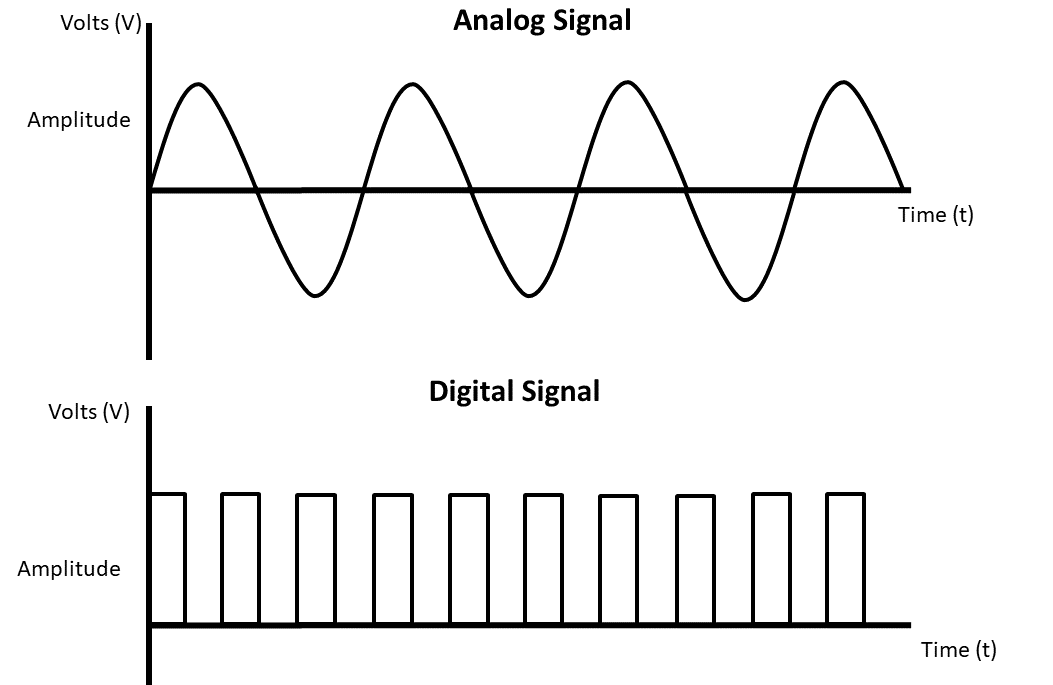
When it first began, a lot of our commonly used devices were considered analog. One example of this would be the old televisions. These have now since been replaced and are now only operated digitally. Analog has become obsolete in the world of technology ever since the digital computers were created. There is necessarily not a superior signal, although it has been shown that digital is favorited in today’s modern technology. The advantages of digital technology in terms of accuracy, flexibility, reliability, scalability, and security make it preferred in many modern industries and domains. The main reasons as to why digital is favored over analog is listed below:
Accuracy and Precision: Digital systems can achieve higher accuracy and precision compared to analog systems. Digital signals can be processed and manipulated without the degradation and noise inherent in analog systems, leading to more reliable and consistent results.
Flexibility: Digital systems offer greater flexibility in signal processing and manipulation. With digital technology, complex algorithms can be applied to data for tasks such as filtering, compression, encryption, and error correction, providing more versatile and adaptable solutions.
Ease of Reproduction and Distribution: Digital data can be easily reproduced, transmitted, and stored without loss of quality. This is especially advantageous in applications such as telecommunications, multimedia, and data storage, where reliable transmission and efficient storage are essential.
Robustness: Digital signals are more robust against noise, interference, and environmental factors compared to analog signals. Digital communication systems, for example, can employ error correction techniques to ensure data integrity even in noisy environments.
Integration and Compatibility: Digital technology allows for seamless integration with other digital systems and devices. This interoperability enables the development of complex systems and networks with diverse functionalities, facilitating innovation and technological advancement.
Cost-Efficiency: While digital technology may require initial investment in hardware and infrastructure, it often leads to cost savings in the long term. Digital components can benefit from economies of scale, become cheaper over time, and offer higher performance for the cost compared to analog equivalents.
Scalability: Digital systems are easily scalable to accommodate varying requirements and expanding needs. Additional functionality or processing power can be added to digital systems through software updates or hardware upgrades, providing scalability and future-proofing capabilities.
Safety and Security: Digital systems can implement advanced security measures such as encryption, authentication, and access control to protect data and ensure system integrity. These features are crucial in applications such as financial transactions, healthcare, and critical infrastructure.
Credit to ChatGPT: Prompt – “why is digital better than analog”